




July 29, 2026
0 Comments

Written by
Team iTatami
How much does a tatami mat weigh? A guide to the weight of sports mats
The weight of a tatami It's not the same for all models. Size, thickness, padding density, lining, and non-slip bottom can significantly affect the final result. To answer your question: “How much does a tatami weigh?” it is therefore necessary to identify the product and its intended use.
Knowing the weight is important for gyms, dojos, and sports clubs that must design the area, organize delivery, or frequently assemble and disassemble the surface. However, weight shouldn't be considered alone: safety and functionality depend on the entire construction system and proper installation.
Content index
How much does a tatami mat weigh? Factors to consider
Module dimensions
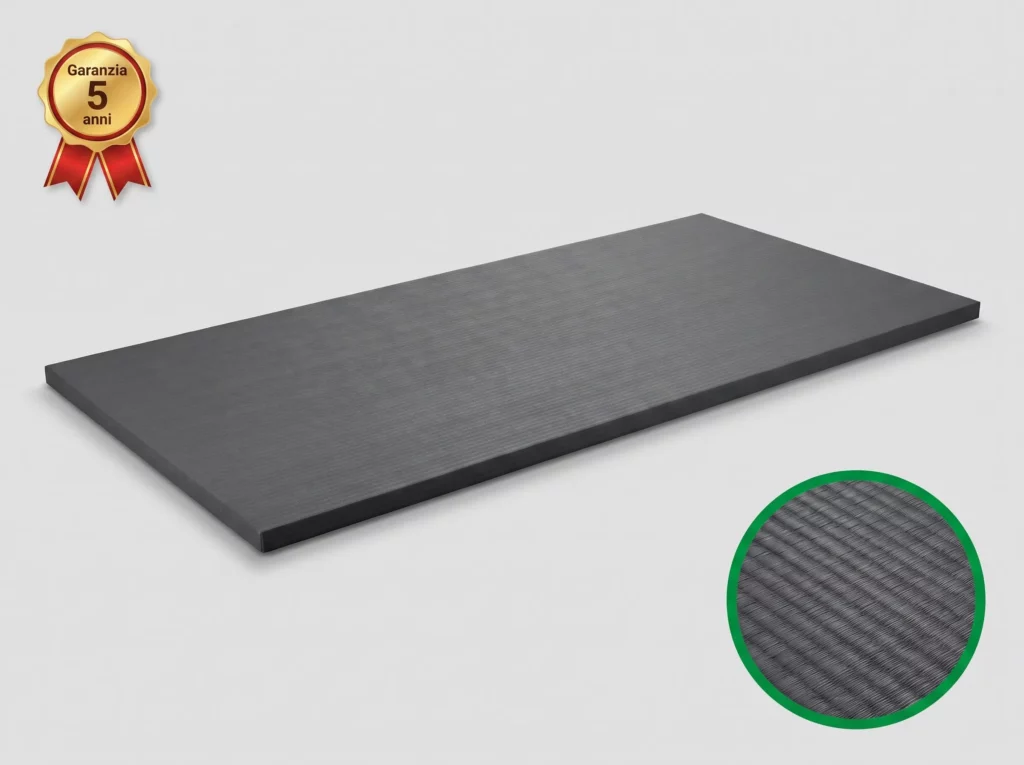
For the same materials and thickness, a larger surface area contains more material and weighs more. tatami 100 × 100 cm covers 1 m², while a 200 × 100 cm element covers 2 m².
The format also affects handling. Square modules are more compact and easier to replace individually; rectangular ones reduce the number of joints, but are bulkier during transport, installation, and storage.
Thickness of the tatami
Among the most frequent searches are: 3 cm tatami And tatami 4 cmGenerally, increasing the thickness increases the volume of the padding, but the weight doesn't always increase proportionally. A thicker product may use a lighter foam, while a thinner model may have a higher density.
The thickness must be chosen based on the discipline and the expected stresses. In judo, for example, the surface must be designed to handle repeated throws and falls.
Materials, density and coating
Density expresses the mass present in a given volume. Given the same dimensions, a denser core tends to weigh more. Expanded foams, polyurethane agglomerates, and EVA have different characteristics in terms of weight, elastic response, absorption, and durability.
The covering and the underlay also contribute to the final value. The technical specifications for iTatami's traditional judo tatami mats indicate a vinyl covering with a rice straw texture, polyurethane foam padding, and, in the available versions, a non-slip underlay.
Judo tatami weight based on size and thickness
The most reliable data is always the one reported in the technical data sheet of the specific model. traditional judo tatami iTatami from 4 cm, the net weight varies according to the size and the presence of the non-slip bottom.
| Typology | Dimensions | Fund | Net weight |
|---|---|---|---|
| Traditional judo tatami | 100 × 100 × 4 cm | Anti-slip | 9.3 kg |
| Traditional judo tatami | 100 × 100 × 4 cm | Without anti-slip | 8.9 kg |
| Traditional judo tatami | 200 × 100 × 4 cm | Anti-slip | 18.3 kg |
| Traditional judo tatami | 200 × 100 × 4 cm | Without anti-slip | 17.4 kg |
| Tatami Judo Pleat Up | 8 × 2 m, thickness 4 cm | Anti-slip | 52.4 kg |
How much does a 100 x 100 cm tatami weigh?
A traditional tatami iTatami from 100 × 100 × 4 cm It weighs 9.3 kg net with a non-slip backing and 8.9 kg without. The size corresponds to one square meter, making it easy to calculate the amount needed to cover a room.
How much does a 200 x 100 cm tatami weigh?
The version from 200 × 100 × 4 cm It weighs 18.3 kg net with a non-slip base and 17.4 kg without. It covers 2 m² and reduces the number of modules, but its length and weight may make it preferable for two people to handle.
How much does a 3cm tatami weigh?
There is no standard value for all 3cm tatamiIt's not correct to calculate this by reducing the weight of a 4 cm model by 25%, because the density, base, and coating may be different. Before purchasing, check the technical data sheet and its suitability for the discipline.
Traditional or folding tatami
A strip Pleat Up 8 x 2 meters and thickness 4 cm weighs 52.4 kg net, equal to approximately 3.28 kg/m²A foldable solution that weighs less than traditional tatami and is suitable for multifunctional spaces.
The comparison shows that two surfaces of the same thickness can have very different weights per square meter. This is due to the different construction technologies, formats, and usage methods.
How to calculate the total weight of the tatami area
The first step is to determine the surface area:
Length × width = square meters
An 8 x 8 meter room measures 64 m². With 100 x 100 cm modules, you'll need 64 elements; with 200 x 100 cm modules, you'll need 32.
The total weight is calculated as follows:
Number of modules × net unit weight = total weight
For 64 m² of traditional tatami mat measuring 100 × 100 × 4 cm with non-slip bottom:
64 × 9.3 kg = 595.2 kg
With 32 modules of 200 × 100 × 4 cm:
32 × 18.3 kg = 585.6 kg
The same surface made with four 8 x 2 meter Pleat Up strips would weigh:
4 × 52.4 kg = 209.6 kg
These values represent the net weight of the products. When arranging delivery, you must also consider packaging, pallets, access to the premises, and available unloading equipment.
Why the weight of the tatami is important
Surface stability
A heavier module may be more difficult to accidentally move, but weight alone does not guarantee stability. A non-slip base, installation precision, perimeter containment, and the characteristics of the floor underneath.
To reduce openings and movements between modules it is useful to follow a correct procedure for fix the tatami, choosing the system based on permanent or temporary installation.
Transport and storage
In dedicated rooms, modules are moved primarily during installation, special cleaning, or replacement. In multipurpose gyms, however, weight and size impact every assembly and disassembly session.
Before choosing it is advisable to evaluate:
- movement frequency;
- number of available operators;
- presence of stairs or narrow corridors;
- storage space;
- dimensions of the folded elements.
To reduce openings and movements between modules it is useful to follow a correct procedure for fix the tatami, choosing the system based on permanent or temporary installation.
Lightweight or heavy tatami: which one to choose?
There's no single best solution. For a permanent dojo, absorption, stability, durability, and compatibility with the discipline are key. For events and multipurpose rooms, speed of installation, space, and ease of transport are even more important.
A heavier tatami is not automatically safer, just as a lighter one is not necessarily less professional. The choice should be based on the technical specifications, usage methods, and design of the entire area. It is useful to compare the dimensions of the judo tatami and the different solutions of Martial arts tatami before defining the supply.
How to choose the right tatami for your dojo
To choose the right product, you need to consider discipline, training intensity, available space, installation type, and handling requirements. The total weight of the area must also be calculated before delivery, especially when access to the dojo is logistically constrained.
THE Made in Italy judo tatami iTatami are available in traditional and foldable configurations, which must be evaluated based on the project. A technical consultation allows you to determine quantities, formats, installation system, and area organization, without relying solely on kilograms.
Design your tatami area
Know How much does a tatami weigh? It helps plan quantities, handling, and storage, but the final choice must above all consider safety, materials, and actual use of the surface.
Request a technical evaluation of iTatami to calculate the overall weight of the supply and design a suitable area for your dojo, gym or sports centre.
713

 English (UK)
  Italiano
  Français