


February 24, 2026
0 Comments

Written by
Team iTatami
Karate tatami measurements: official competition area dimensions and safety
In karate, the tatami area measurements are designed to ensure stability, control and safety in rapid movements, rather than absorbing high-intensity throws like in judo. The discipline, in fact, relies on explosive accelerations, sudden changes of direction, and controlled stops, elements that require a stable and well-defined surface.
Unlike throwing martial arts, in karate the focus is not so much on the vertical absorption of the impact, but on the precision of support and continuity of the playing areaFor this reason, the dimensions of the central area and the safety edge must be carefully respected, especially in competitive contexts.
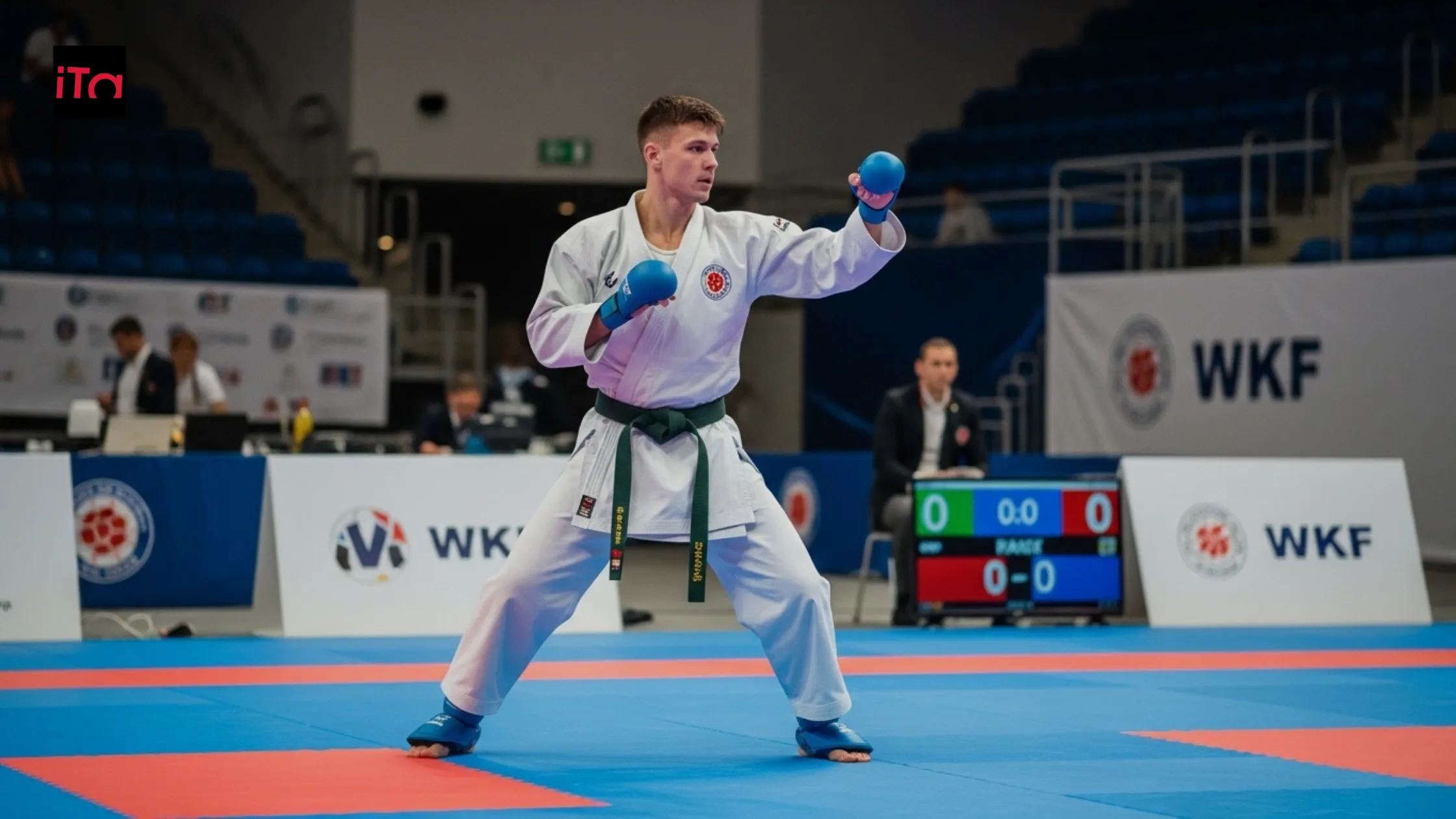
The guidelines established by the World Karate Federation They define precise standards for the competition area, clearly distinguishing between the fighting zone and the perimeter safety zone. Even in non-competitive dojos, designing the tatami area according to these proportions improves the quality of training and prepares athletes for a real-world competition.
In this guide we analyze in detail the Karate tatami measurements, the role of the safety edge and the technical measures useful for designing a functional dojo that complies with international standards.
🎯 Find out more about our Tatamis with our Catalogue
iTatami Tatmi are designed down to the smallest detail to ensure safety for athletes in every martial arts discipline.
Find out more →
iTatami Tatmi are designed down to the smallest detail to ensure safety for athletes in every martial arts discipline.
Find out more →
Content index
Official rules for the Karate competition area
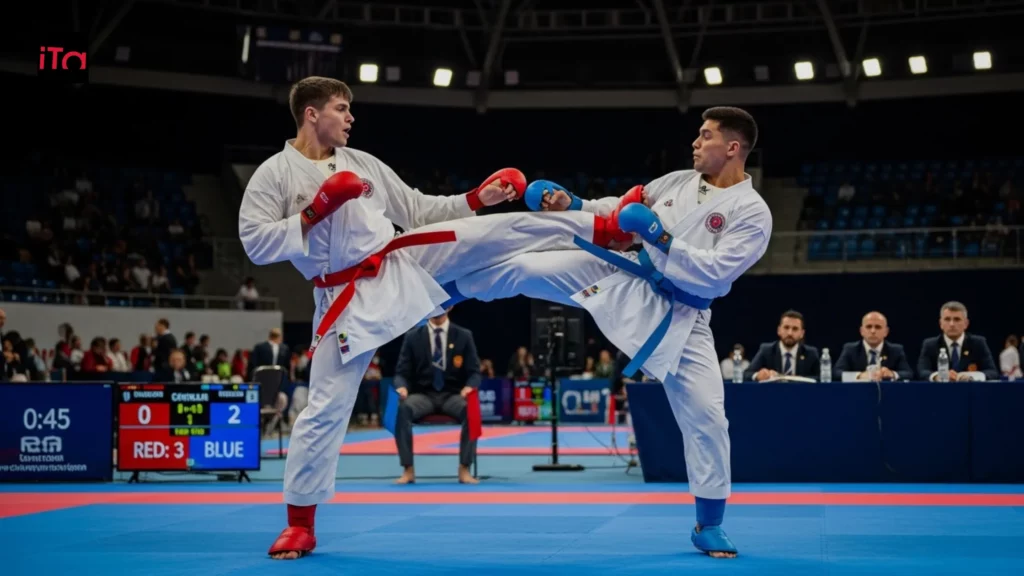
In karate, the competition area is defined by precise criteria that guarantee safety, fairness and uniformity in competitionsThe rules established by the World Karate Federation clearly distinguish between central combat zone And perimeter safety edge, two complementary elements but with different functions.
Understanding this structure is essential not only for organizing competitions, but also for designing a dojo that reflects official standards.
Structure of the competition area
The competition area in karate is composed of:
Central area (combat area): operational space where kumite or kata is performed
Safety edge: perimeter band surrounding the central area
The surface must be:
perfectly flat
continuous, without differences in level
stable, to ensure secure support during rapid changes of direction
Unlike judo, karate's action is predominantly dynamic and controlled, with lateral movements and explosive advances. For this reason, the quality of the surface is as crucial as its size.
Safety edge function
The safety edge In karate, it has a preventative function. Although it doesn't have to absorb throws like in judo, it is essential for:
protect athletes in case of a rapid exit from the central area
avoid impacts against rigid surfaces or lateral structures
maintain continuity of movement during the action
In kumite, in particular, movements are fast and unpredictable: an adequate perimeter band reduces the risk of injury and allows athletes to express their technique without forced braking.
Even in dojos dedicated exclusively to training, replicating the official structure of the competition area improves safety, professionalism, and competitive preparation.
Official Karate Tatami Dimensions
The official measurements of the Karate tatami They are designed to ensure safety, visibility, and uniformity in competitions. The competition area must respect precise proportions to ensure equal conditions for all athletes.
According to the standards of the World Karate Federation, the official configuration of the tatami area is as follows:
Karate competition area measurements
Central area (combat zone): 8 × 8 meters
Safety edge: 2 meters per side
Total area: 12 × 12 meters
How to calculate the total area
The central area from 8×8 m represents the operational space for kumite and kata. Around this a perimeter band is provided 2 meters per side, which brings the entire surface to 12×12 meters overall.
This structure allows you to:
ensure a safe distance in case of a rapid exit
avoid impacts against walls or obstacles
maintain continuity and control of the action
Why are the measurements different from Judo?
Karate doesn't involve high-intensity throws like judo. For this reason:
The the safety edge is smaller (2 m instead of 3 m)
the space is designed for explosive and controlled movements
the priority is the stability of the surface rather than the vertical absorption of the impact
Even in non-competitive dojos, maintaining these proportions improves the quality of training and prepares athletes for the official competitive context.
Kumite vs. Kata: Is there a difference in size?
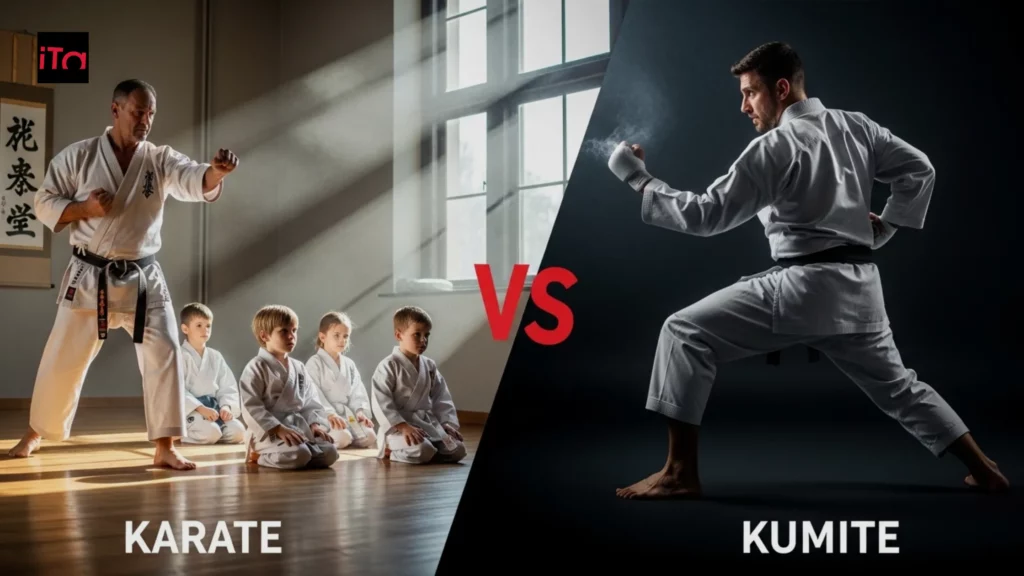
From a regulatory point of view, the Karate tatami area dimensions They remain the same for both kumite and kata. However, the actual use of space and technical requirements change significantly.
Space
Kumite (combat)
Continuous and dynamic movement
Lateral and forward movements
Possible quick exits from the central area
Here the space is exploited in a broad and unpredictable way, making the presence of the 2-meter safety edge.
Kata (forms)
Codified and controlled movement
Structured technical sequences
More centered and predictable space
In kata the athlete uses the area in a more geometric way, but the 8x8 m dimension still guarantees complete freedom of execution.
Stability
In kumite stability is essential for:
rapid changes of direction
sudden stops
explosive reactions
In kata, however, stability serves to:
maintain technical precision
ensure control in static passages
avoid micro-imbalances
In both cases, the surface must be uniform and continuous, with no differences in level between the central area and the edge.
Actual use of the area
Although the dimensions are identical, in kumite the entire central area is used in a variable and dynamic way.
In kata, however, the use of space is more predictable but requires a perfectly stable surface to avoid compromising balance.
In short: the dimensions do not change, but the intensity and method of use of the tatami area do.
Recommended Karate Tatami Thicknesses
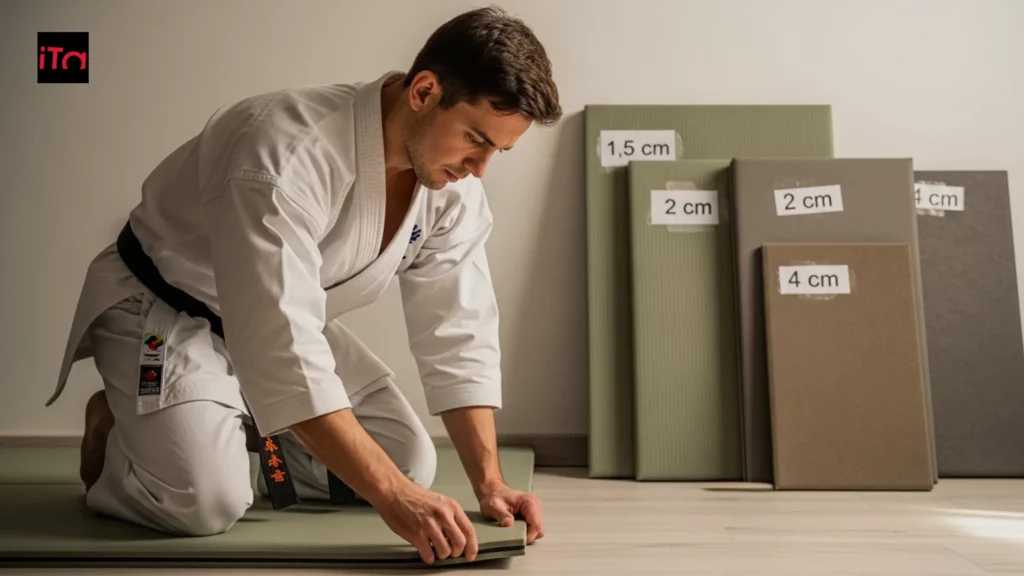
In karate, the choice of the thickness of the tatami must prioritize stability and reactivity, rather than vertical impact absorption.
Recommended thickness: 2–4 cm
For karate practice, a thickness of between 2 and 4 cm, with medium-high density.
This configuration allows you to:
maintain stable supports
ensure speed of movement
avoid excessive sinking
Because less thickness than Judo
In judo, high energy throws and falls are frequent, requiring 4–5 cm thick to dissipate the impact.
In karate:
no intense vertical projections are expected
the work is mostly standing
the priority is stability, not mass absorption
A tatami that is too soft would compromise:
balance
reaction speed
technical precision
Control and responsiveness
In kumite, the surface must allow:
explosive departures
controlled braking
rapid changes of direction
In kata, however, a solid foundation is needed to support:
stable postures
precise transitions
center of gravity control
For this reason, in karate it is essential to find the right balance between adhesion, density and thickness, avoiding surfaces that are too soft or too rigid.
Karate dojo layout: stability and spatial organization
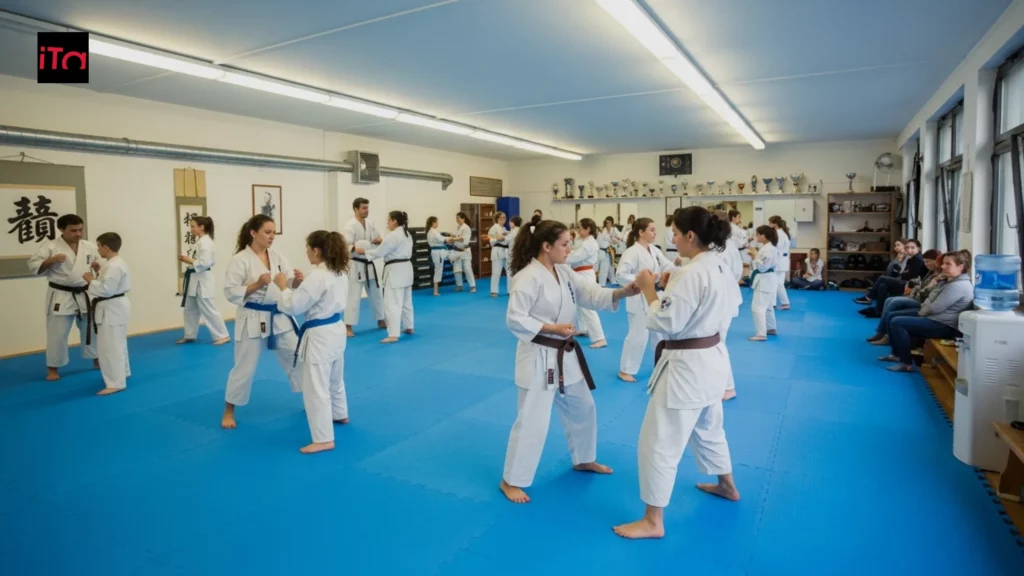
In karate, the layout of the dojo must be conducive to smooth movement, safety and technical controlEven with correct measurements (8x8 m + 2 m edge), imprecise design can compromise the stability and functionality of the tatami area.
Unlike judo, here the priority is not the absorption of falls, but the continuity of support and management of dynamic space.
Location of the entrances
Entrances to the tatami area must:
be outside the total area (12×12 m)
do not interrupt the safety edge
avoid crossing the central area
In kumite, movements are rapid and unpredictable: a poorly placed entry can become a critical point during training.
The tatami area must remain visually and functionally “closed”.
Surface continuity
The surface must be:
perfectly flat
without any differences in level between the central area and the edge
uniform in elastic response
In karate, a tatami that is too soft or has unstable joints can cause:
loss of balance
micro-joint traumas
difficulty changing direction
Safety edge management
The safety edge from 2 meters per side must:
be continuous throughout the perimeter
do not end directly against walls or obstacles
maintain the same stability of the central area
While there are no high-energy throws in karate, quick exits can take the athlete to the edge of the boxing area.
Organizing the space for training
A well-designed Karate dojo should include:
free perimeter space around the tatami area
instructor and observation area outside the total area
absence of rigid equipment in the immediate vicinity
The goal is to create a space that accompanies movement, not limits it.
Design your Karate dojo correctly

Now that you know the official measurements of the Karate tatami, the next step is to fit them correctly into your actual space.
Every dojo has different needs: size, number of participants, intensity of use. A customized configuration avoids structural errors and improves safety and performance.
Request custom Karate tatami
We can help you with:
-
8×8 race area configuration + safety edge
-
choosing the ideal thickness (2–4 cm)
-
functional dojo layout design
-
customized solutions for gyms and ASDs
You can request a free consultation by clicking the following link: contacts
1158
 English (UK)
  Italiano
  Français